
[UPDATED 6/05/2023]
Information about the 2023 Board of Ed Budget Process:
The Milford Board of Education proposed a 4.392% budget increase to cover essential costs and contractual requirements — a reasonable request in the face of inflation rates (6.5 percent!), a teacher shortage, rising fuel costs, and new state mandates. (Watch the complete budget presentation here to learn more). But on March 15, in a split vote, the Board of Finance voted to allow only a 2.58% increase – slashing $1,844,816 in requested funds.
That leaves our Board of Ed in crisis since they need to meet higher expenses regardless. This means significant cuts to existing staff and valuable programs in our schools.
What was the impact of the Board of Finance vote?
On March 15, the Board of Finance slashed the adopted Board of Ed budget by $1,844,816. Allowing this cut to stand would have a devastating impact on our schools.
The adopted Board of Education budget amount was a 4.392% increase, of which nearly 90% was already accounted for by inflation and contract requirements. The Board of Finance’s 2.58% represents a cut to the current services and WILL have an impact on our schools. To put this into perspective a similar budget reduction of 2.2 million in 2010 was a major factor in the closing of Simon Lake Elementary School. This cut means the threat of:
- losing another one of our schools,
- loss of sports and extracurriculars,
- class size increases across the board,
- wiping away the progress we have made toward high-quality education, world languages in all grades, career pathways, STEM labs, and more to accommodate a cut this
The Board of Education had a deep conversation about the potential impacts on March 27th. Watch the meeting here.
What justifies this increase?
Since 2021, inflation rates have ranged from 6 – 7%. We are facing rising fuel costs, and a teacher shortage, are committed to increased costs from a new teacher contract, and need teachers and staff to address the academic impacts and mental health challenges of the pandemic.
Milford has a track record of fiscal responsibility, with historically low increases relative to other districts, all while making great progress as a district in high-quality instruction, class sizes conducive to learning, world languages, STEM labs in Elementary Schools, and career pathway offerings.
We have done more with less very often. Historically, requests have been very small and increases averaged 1.44% over each of the last 10 years, even as our contractual obligations are typically around 3%. Now we are at a point where Milford schools cannot continue to absorb this difference without cutting programs and staff.
What is the cost to taxpayers?
For someone who owns a home with a median property value of $400,000, you would pay an additional $42 a YEAR in taxes to safeguard high-quality education in Milford. That’s it.
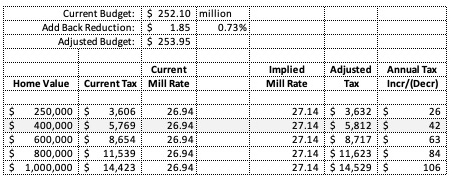
We recognize that this may present a hardship. One option to address hardship is the opportunity for tax relief for elderly and disabled persons provided by Milford. Section 20.5-6 – Property tax relief for qualified elderly persons and totally disabled persons.
Are the schools top-heavy with extra administration? Do we have more teachers than we need for the size of the student population?
NO. These are false statements. We have had the same number of administrators for the last 10+ years. The world languages and STEM teachers were already in previously approved budgets.
What if I want to focus on one issue, like no cuts to world languages?
That is understandable. However, we believe it is a false narrative because Milford has the means and opportunity to make the necessary investments as outlined above.
What do I need to know about enrollment in Milford schools?
There has been a decline year over year, however, that has slowed, and demographers predict that it will slowly increase. We have been working to manage a decline across 13 schools and 13 grades. A review of classroom sizes shows that Milford schools are on par across the board.
This is an economic issue. Meaningful investments into schools mean thriving cities: people choosing to move into and stay in Milford. A 2020 study found that a 1% increase in school spending increases the value of homes by .95 percent. Households highly value spending on the salaries of teachers and staff.1
- National test results show the pandemic’s devastating effects on American schoolchildren, with some scores falling by the largest margin in more than 30 years. Declines were seen across almost all race, ethnicity and income levels, but were markedly worse for the most vulnerable students.2 Experts state that these tests are “quite predictive of [children’s] success later in school, and their educational trajectories overall.”
- Significant increases in mental health challenges among children, adolescents, and their families led the American Academy of Pediatrics and Children’s Hospital Association to declare a national state of emergency on these issues.3
This is a workforce issue. Milford’s decision-makers have led strong progress toward high-quality education, world languages in all grades, career pathways, STEM labs and more. These are supports our students need to be prepared for the workforce.
Make no mistake. This is a sensible budget that covers required investments – in staff, teachers, counselors, and high-quality education, to make now for long-term results.
********************************************************************************************************
1Bayer, P.J., Blair, P.Q., Whaley, K. A National Study of Public School Spending and House Prices. 2020. https://www.hks.harvard.edu/sites/default/files/Taubman/PEPG/colloquium/2021-02-18-pepg-colloquium-blair-et-al.pdf
2American Academy of Pediatrics. AAP-AACAP-CHA Declaration of a National Emergency in Child and Adolescent Mental Health. 10/19/21.. https://www.aap.org/en/advocacy/child-and-adolescent-healthy-mental-development/aap-aacap-cha-declaration-of-a-national-emergency-in-child-and-adolescent-mental-health/
3American Academy of Pediatrics. AAP-AACAP-CHA Declaration of a National Emergency in Child and Adolescent Mental Health. 10/19/21.. https://www.aap.org/en/advocacy/child-and-adolescent-healthy-mental-development/aap-aacap-cha-declaration-of-a-national-emergency-in-child-and-adolescent-mental-health/
How to Contact Your Alderman
 Don’t know your electoral district?
Click here to find it on the electoral map.
ALDERMEN CONTACT INFO
| FIRST DISTRICT | PHONE | |
| Matt Arciuolo II (D) | marciuolo@milfordct.gov | 203-951-1396 |
| Anthony Giannattasio (R) | agiannattasio@milfordct.gov | 203-876-1238 |
| Michelle Parente (D) | MParente@milfordct.gov | 203-713-6370 |
| SECOND DISTRICT | ||
| Robert Pacelli, Jr. (D) | rpacelli@milfordct.gov | 203-360-4668 |
| Scott Marlow (R) | smarlow@milfordct.gov | 203-877-7573 |
| Ward Willis (D) | wwillis@milfordct.gov | (203) 306-7025 |
| THIRD DISTRICT | ||
| Holly E. Mulrenan (D) | HMulrenan@milfordct.gov | 203-878-9807 |
| Brett Broesder (D) | bbroesder@milfordct.gov | 203-781-6764 |
| Michael S. Casey (R) | mcasey@milfordct.gov | 203-877-8299 |
| FOURTH DISTRICT | ||
| John Moffitt (D) | jmoffitt@milfordct.gov | 203-680-8416 |
| Philip J. Vetro (D) | pvetro@milfordct.gov | 203-874-7276 |
| Daniel J. German (R) | dgerman@milfordct.gov | 203-878-3520 |
| FIFTH DISTRICT | ||
| Gregory F Harla (D) | gharla@milfordct.gov | 203 877-5611 |
| Ellen Russell Beatty (D) | ebeatty@milfordct.gov | 203-915-2308 |
| Raymond G. Vitali (R) | rvitali@milfordct.gov | 203-878-1590 |
 MilfordEd Advocates